Factors Influencing University Students' Employment Intentions
A Meta-Analytic Synthesis from the Perspective of the Theory of Planned Behavior
Abstract: Against a structural backdrop in which graduate numbers in China reach successive record highs alongside the coexistence of "slow employment" and the "civil service craze", systematically identifying the key factors that shape university students' employment intentions has considerable practical significance. Drawing on the Theory of Planned Behavior (TPB) as its core framework, this study integrates Social Cognitive Career Theory (SCCT) and push-pull theory to construct a four-level ("individual-family-university-society") model of influencing factors, and conducts a random-effects meta-analysis of 10 published empirical studies comprising 26 effect sizes. The results show that employment self-efficacy / perceived behavioural control (\(r^{+}=0.412\), \(95\%\,CI\,[0.257, 0.547]\), \(k=8\)) and outcome expectations / attitude (\(r^{+}=0.410\), \(95\%\,CI\,[0.321, 0.491]\), \(k=4\)) are the most robust proximal predictors of employment intention; internship and practical experience (\(r^{+}=0.459\), \(k=3\)) and subjective norm (\(r^{+}=0.355\), \(k=5\)) follow; perceived policy support (\(r^{+}=0.237\), \(k=2\)) and perception of the employment situation (\(r^{+}=-0.118\), \(k=2\)) yield weak positive and weak negative pooled effects respectively; and employability and family socioeconomic status have too few available effect sizes (\(k=1\)) to pool, and are discussed alongside qualitative evidence. Heterogeneity analysis shows that most pathways exceed \(I^2=76\%\), and subgroup analyses indicate that the direction of effects is consistent but their magnitude differs between Chinese and international samples and between entrepreneurial and job-seeking / industry employment intentions; leave-one-out tests confirm the robustness of the main conclusions. The study accordingly proposes that university careers guidance should shift from "information delivery" to "efficacy cultivation", and promote coordinated action among families, universities and the policy system.
Keywords: university students; employment intention; Theory of Planned Behavior; meta-analysis; random-effects model; influencing factors
1. Introduction
Employment is the most fundamental livelihood. In 2024 the number of university graduates in China was projected to reach 11.79 million, another historic high [1]. In a labour market where aggregate pressure and structural contradictions overlap, graduates' destination choices exhibit marked diversification alongside a pronounced preference for "stability". Tracking surveys by MyCOS Research Institute show that, among the class of 2023, the proportion pursuing domestic postgraduate study slowed to 17.6% and the unemployment rate stood at 7.4%, while about a quarter of those "awaiting employment" were preparing full-time for civil service and public institution recruitment examinations, with the number of examination candidates doubling as a share of all graduates within five years [2]; among the class of 2024, 60.6% were in paid employment, 24% of those without a confirmed destination were preparing full-time, and the combined share entering government bodies / public institutions and state-owned enterprises approached 40% [3]. A Zhaopin survey of 24,900 new graduates likewise shows that the proportion wishing to work in state-owned enterprises rose for five consecutive years from 36% in 2020 to 47.7% in 2024, and that 51% considered "stability most important" [4]; its 2023 survey also found a three-year continuous rise in state-owned enterprise preference (42.5% → 44.4% → 46.7%) [5].
Accompanying the "preference for the public sector" has been the growing visibility of "slow employment". A 2023 special survey by the Shanghai Survey Team of the National Bureau of Statistics of over 4,000 new graduates found that 38.0% of respondents were in a state of "slow employment", comprising 32.0% pursuing further study and 6.0% delaying employment [6]; policy interpretations from human resources and social security authorities distinguish active from passive forms of "slow employment", and identify family economic conditions, career-planning ability and the supply of employment services as important variables shaping the phenomenon [7]. Further study, civil service examinations, entrepreneurship, grassroots employment, returning to one's home town and delayed employment together constitute the complex map of university students' employment intentions, shaped both by the objective constraints of labour-market signals and by the subjective construction of individual cognition, family expectations and the policy environment.
Employment intention merits study as a distinct scientific question because it sits at the intersection of "structure" and "agency". From the structural end, labour-market conditions, industrial restructuring and the mismatch between educational supply and demand define the feasible set of choices, a set that narrows continuously as graduate numbers climb; from the agency end, identical market signals are processed through individual cognition, intergenerational family negotiation and university guidance, ultimately crystallising into differentiated distributions of intention. Although policy has intensively promoted grassroots employment, flexible employment and expanded educational capacity, whether policy resources translate into changes in intention and behaviour depends on mediating psychological processes such as perception, expectation and competence judgement. Quantitatively estimating these processes both tests behavioural theory against a major real-world issue and provides evidence for selecting "leverage points" for policy intervention.
Considerable empirical research has accumulated, in China and internationally, on the factors influencing university students' employment intentions: some apply the Theory of Planned Behavior (TPB) to examine the explanatory power of attitude, subjective norm and perceived behavioural control for career intention; others examine self-efficacy and outcome expectations within Social Cognitive Career Theory (SCCT); and others analyse the push and pull effects of the macro-environment and policy from a push-pull perspective. However, these studies differ considerably in the selection of predictors, the form in which effect sizes are reported and the sample context, so the conclusions of any single study cannot answer "which class of factor matters most, how large is the effect, and how far does it vary across contexts?" Fragmented and incommensurate empirical evidence leaves university careers guidance and policy-making without comparable quantitative grounds.
On this basis, the present study adopts TPB as its core framework, integrates SCCT and push-pull theory, and conducts a meta-analysis of available domestic and international empirical studies. It estimates the pooled effects and sources of heterogeneity between eight key predictors (employment self-efficacy, outcome expectations / attitude, subjective norm, perception of the employment situation, employability, family socioeconomic status, internship and practical experience, and perceived policy support) and university students' employment intentions, corroborating the findings with authoritative Chinese survey data, with a view to providing a systematic evidence base for university career education and employment policy.
2. Literature Review and Theoretical Framework
2.1 The Theory of Planned Behavior and its application to employment
The Theory of Planned Behavior proposed by Ajzen holds that behavioural intention is the immediate antecedent of a specific behaviour, and that intention is in turn jointly determined by three proximal variables: attitude toward the behaviour, subjective norm and perceived behavioural control [8]. Attitude refers to the individual's evaluation of the outcomes of performing the behaviour; subjective norm reflects the social pressure generated by the expectations of significant others (parents, peers, teachers); and perceived behavioural control concerns the perceived ease or difficulty of performing the behaviour, comprising control beliefs and self-efficacy. The theory has received meta-analytic support across a wide range of behavioural domains including health, environmental protection and vocation, with Armitage and Conner's synthesis of 185 studies showing that attitude, subjective norm and perceived behavioural control together explain a substantial share of variance in intention [9].
In the vocational and employment domain, job-search intention is regarded as the most stable antecedent of job-search behaviour. Blau conceptualised job-search behaviour along two dimensions—forbearance and formal job search [10]; Kanfer and colleagues' meta-analysis confirmed that personality and self-related variables stably predict job-search behaviour [11]. TPB studies using student samples broadly support the three-variable model: a regression analysis of Malaysian fresh graduates found perceived behavioural control to be the strongest predictor of job-search intention [12,13]; a meta-analytic path analysis of Vietnamese students identified entrepreneurial attitude and self-efficacy as important direct antecedents of entrepreneurial intention [14,15]; and research on South African graduates confirmed the contribution of subjective norm and control beliefs to application intention [16]. In the Chinese context, TPB-based studies have covered self-employment intention, return-home employment intention and grassroots employment intention, among other career types [17,18,19].
Nevertheless, no consensus has emerged on the relative strength of the TPB antecedents in the employment domain. Disagreement focuses on two points. First, the role of subjective norm: some studies observe no significant direct path to entrepreneurial intention and only an indirect effect through attitude [15], while a Korean sample showed a correlation as high as 0.569 for peer influence while individual-trait variables lost significance in the adjusted model [20], suggesting that normative effects may be amplified or obscured by cultural context and measurement. Second, there is controversy over the measurement of perceived behavioural control: path coefficients differ markedly between studies that combine control beliefs with self-efficacy in a single report and those that model them separately, directly undermining cross-study comparability. Moreover, TPB's proximal framework says relatively little about distal variables such as "competence accumulation" and "policy resources", and must be linked to SCCT and push-pull theory to cover the full causal chain of university students' employment intention—this is the methodological motivation for the integrated framework adopted here.
2.2 Complements from Social Cognitive Career Theory and push-pull theory
SCCT introduces Bandura's self-efficacy theory into the career-choice process, proposing that career interests, choice goals and performance are shaped by three core variables—self-efficacy, outcome expectations and personal inputs—and their interactions [21,22]; career decision-making self-efficacy, as its operationalisation in career-decision contexts, has developed mature measurement instruments validated among Chinese university students [23,24]. Compared with TPB, SCCT places greater emphasis on the sources of competency experiences and environmental support, offering a "competence-support" explanatory route for perceived behavioural control; its career self-management model further situates adaptive career behaviour within a dynamic system of "personality/disposition-cognition-environment" [25]. Sheu and colleagues' meta-analytic path test of the 1981-2008 literature showed that environmental support and barriers act on choice goals partly through the mediation of self-efficacy and outcome expectations, and that the contributions of self-efficacy and outcome expectations to interests and goals hold across all six Holland themes [26]. This benchmark implies that, when examining university students' employment intention, the layered logic of treating efficacy and expectations as proximal variables and environmental support as a distal variable is robust across contexts.
Push-pull theory provides a framework for macro-level factors. Lee's classical migration theory decomposes the migration decision into push factors at the place of origin, pull factors at the destination and intervening obstacles [27]. Translated to employment-choice research, perception of the employment situation (employment pressure, risk perception, economic confidence) constitutes a "push-resistance" system: the higher the perceived risk, the lower the intention toward a given destination [19]; while policy support (grassroots employment subsidies, talent attraction schemes, entrepreneurship support) constitutes a "pull", guiding the flow of intentions by altering expected returns [17,28]. In recent years, domestic research using the push-pull framework has discussed phenomena such as the "enthusiasm for public-sector employment in county areas" and "return migration", noting that high housing prices and competitive pressure in large cities create push factors while stability and emotional ties in one's home town create pull factors [29].
2.3 Empirical advances in research on university students' employment intentions
The accessible empirical literature reveals three main strands. First, the psychological-cognition strand: self-efficacy variables (employment self-efficacy, career decision-making self-efficacy, job-search self-efficacy) and outcome expectations / attitude have repeatedly been confirmed as significant positive predictors of career intention; for example, the correlation between perceived behavioural control and self-employment intention reached 0.63 in a sample of Chinese nursing undergraduates [18]; the positive effect of employability (self-perceived employability, competence) on job-search intention is supported in Indonesian, Portuguese and other samples, though effect magnitudes differ considerably [30,31,32,33]; Chinese research also finds that innovation capability and social adaptability influence employment readiness through employability [34], and that general self-efficacy enhances the employability of financially disadvantaged students through achievement motivation and career aspirations [35]. Second, the social-environment strand: family and peer influence, as operationalisations of subjective norm, are significantly positively related to entrepreneurial or job-search intention in Korean, Malaysian and Nigerian samples [20,12,36]; Chinese research using randomly assigned class data confirms that peers' positive employment behaviour significantly raises individual employment intention, while family background support weakens this peer effect [37]; the direction of family socioeconomic status varies by intention type—better family financial conditions predict lower interprovincial return employment intention [29] but a higher likelihood of "slow employment" [7,38,39]. Third, the experience-and-institution strand: practical experiences such as internship satisfaction and internship achievement strongly explain industry career intention [40,41], and survey evidence indicates that slow employment results from the combined action of family, individual and society [42], while a follow-up of western Chinese medical graduates cautions that initial employment intentions may not match final choices [43]; perceived employment policy positively predicts grassroots and entrepreneurial intentions in Chinese samples [17,28], but its direct effect is unstable in international samples [36,44].
It is worth noting that most studies rely on a single convenience sample and adopt different statistical conventions (Pearson correlation versus standardised regression / path coefficients), leaving little comparability between single-point findings; some report only significance without effect sizes, as with the relationship between policy perception and grassroots employment intention in a western Chinese sample [17]. Bringing scattered evidence into a common effect-size metric for quantitative synthesis is the point of departure of this study.
The "slow employment" literature offers another window on intention research. Unlike studies of active career choice, slow-employment research attends to the "delayed" and "wait-and-see" forms of intention: local surveys show that family, individual and social factors jointly contribute to slow employment [42], and that graduates whose parents have higher educational attainment are more inclined toward slow employment [39]; analyses based on national survey data further find that the emotional stress arising from inadequate employment security and frustrated identity is a principal source of pressure, and that career self-efficacy and outcome expectations differ significantly across subtypes of slow employment (confused exploration, passive preparation, ideal persistence and avoidant withdrawal). Although these findings mostly report nopoolable effect sizes, they resonate with the efficacy, expectation, norm and situation-perception variables in the present framework.
2.4 Theoretical integration and analytical framework
Synthesising the three theoretical strands above, this study constructs a four-level ("individual-family-university-society") framework of influencing factors (see Figure 1). The individual level corresponds to TPB's attitude-control cognitions and SCCT's self-efficacy, outcome expectations and employability; the family level to subjective norm (parental and peer expectations) and family socioeconomic status; the university level to internship and practical experience and careers education; and the societal level to perceived policy support and employment-situation perception (push/pull). The four levels of variables act on employment intention through a "cognition-motivation-intention" chain, and their relative strengths can be ranked by pooled effect sizes from the meta-analysis.
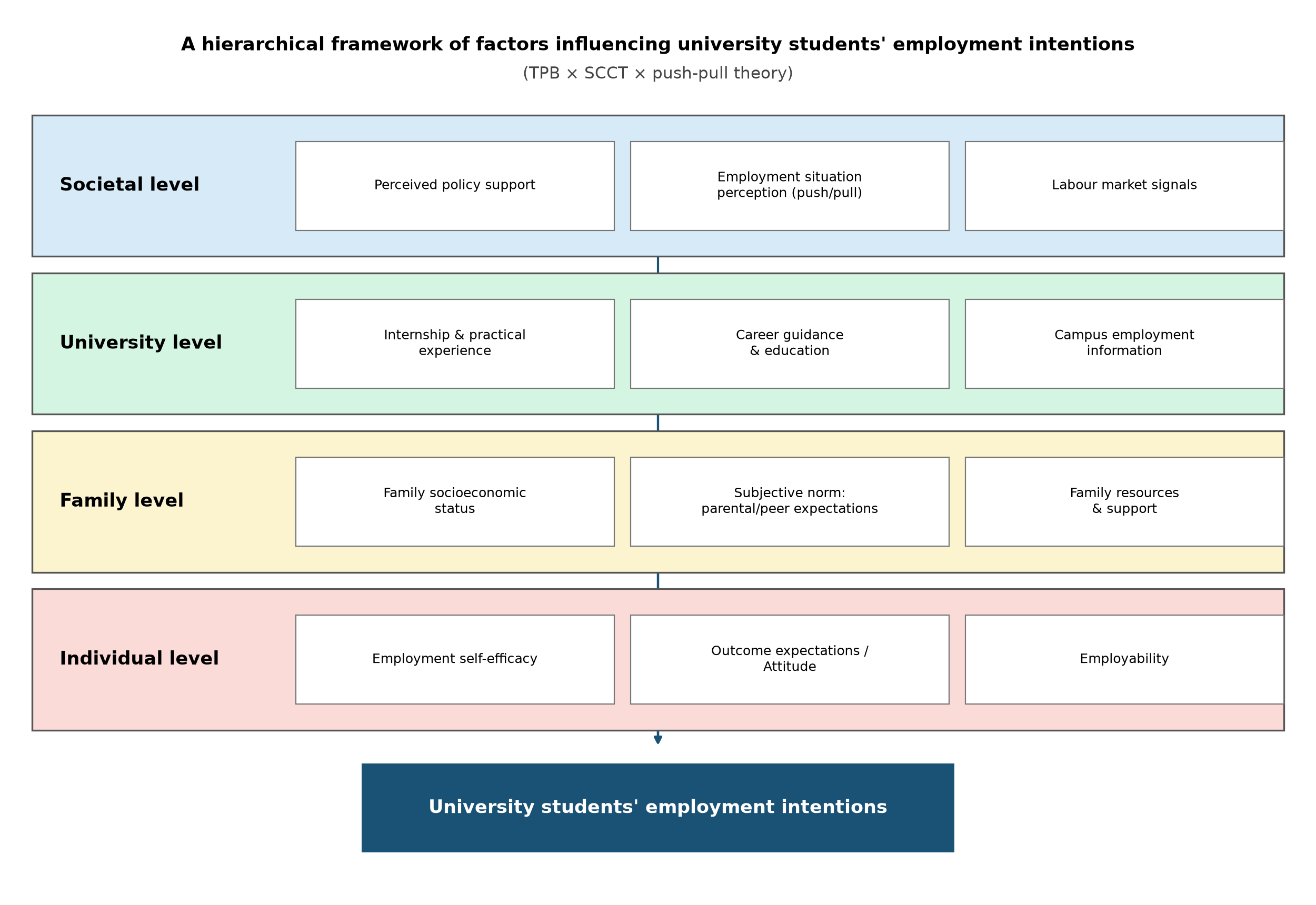
Figure 1. A hierarchical framework of factors influencing university students' employment intentions (TPB × SCCT × push-pull theory)
3. Research Design and Data
3.1 Search strategy
This study conducted a systematic search of published Chinese- and English-language empirical literature, covering January 2000 to October 2026. The English search drew on open-access resources accessible through web search tools (DOAJ, PubMed Central, journal websites and institutional repositories), while the Chinese search covered the open journals of Hans Publishers, open-access literature on China National Knowledge Infrastructure and university institutional repositories. Search strings were constructed around the three elements "population-outcome-predictor", principally including "college students employment intention survey", "career decision TPB path coefficient students", "graduate employability intention structural equation", "rural employment intention college students China", "civil service intention graduates China", "entrepreneurial intention students meta-analysis" and "job search intention self-efficacy correlation", together with equivalent Chinese-language search terms for the concepts of university students' employment intention, return-home employment intention, slow employment, civil service examination intention, grassroots employment and perceived policy support. The search strategy and screening process are summarised in Table 1.
| Stage | Content |
|---|---|
| Search platforms | DOAJ, PubMed Central, Frontiers, MDPI, Wiley, Emerald institutional repository, ScienceDirect open articles, Hans Publishers journals, Tsinghua University education research OA platform, Shihezi University thesis repository and other open resources |
| Time span | January 2000 - October 2026 |
| Population | Current or new university graduates (junior college, undergraduate, postgraduate) |
| Outcome | Employment / career intention dependent variables: employment intention, job-search intention, entrepreneurial (self-employment) intention, return-home / grassroots employment intention, industry career intention, slow-employment tendency |
| Initial screening | Title/abstract screening → deduplication → full-text availability check → effect-size extractability check |
| Exclusion criteria | (1) Non-university samples (e.g. secondary-school students, working adults); (2) purely theoretical or review articles; (3) studies reporting no convertible effect size (r or standardised β); (4) studies whose full text is unavailable (cited only qualitatively in the discussion); (5) binary studies reporting only logistic coefficients (excluded from pooling because of strong conversion assumptions) |
| Final inclusion | 10 studies, 26 effect sizes, covering samples from China, South Korea, Malaysia, Indonesia and Nigeria, with a cumulative sample of 5,114 person-observations |
3.2 Characteristics of the included studies
Table 2 presents the basic characteristics of the 10 included studies. The studies span 2021-2026, comprising four Chinese samples (cumulative N=3,687) and six international samples (cumulative N=1,427). The dependent variables cover entrepreneurial / self-employment intention (4), job-search intention (2) and industry / regional employment intention (4, including return-home employment and hotel-industry career intention). The theoretical frameworks are predominantly TPB and its extensions (5), with SCCT / socio-ecological models, internship-outcome models and push-pull / benefit-risk models among the rest. Effect sizes are reported as Pearson correlation r (16), standardised regression / path coefficient β (8) and r converted from between-group t values and coefficients of determination (2).
| No. | Study | Year | Country/region | N | Sample and dependent variable | Framework | Effect type |
|---|---|---|---|---|---|---|---|
| 1 | Yang et al.[18] | 2025 | China (Yunnan) | 936 | Nursing undergraduates; self-employment (flexible) intention | TPB | r |
| 2 | Xu et al.[19] | 2025 | China (Zhejiang) | 528 | Medical students; return-home employment intention | TPB × benefit-risk | β |
| 3 | Zhang et al.[45] | 2026 | China (Hunan) | 1016 | Undergraduates; return-home employment & entrepreneurship intention | TPB × social support × psychological capital | r (incl. t-conversion) |
| 4 | Qu et al.[40] | 2021 | China (Guangdong) | 207 | Hotel-management interns; industry career intention | Internship-outcome model | β |
| 5 | Jumbri et al.[46] | 2026 | Malaysia | 300 | TVET undergraduates; self-employment intention | TPB × entrepreneurship education | r |
| 6 | Lim et al.[20] | 2026 | South Korea | 205 | Nursing undergraduates; entrepreneurial intention | Socio-ecological model | r |
| 7 | Bularafa & Gamawa[36] | 2021 | Nigeria | 383 | Undergraduates; entrepreneurial intention | TPB × contextual factors | r/β |
| 8 | Prameswari[41] | 2025 | Indonesia | 253 | Tourism vocational students; industry career intention | Internship-outcome model | β (R²-converted) |
| 9 | Tiarapuspa et al.[33] | 2026 | Indonesia | 197 | Generation Z job seekers; job-search intention | Extended SCCT | β |
| 10 | Low et al.[13] | 2025 | Malaysia | 139 | Business undergraduates; job-search intention | TPB | β |
3.3 Effect-size extraction and conversion rules
The study takes the correlation coefficient r as the target effect size. Extraction followed three rules. First, when a study reported both Pearson correlations and structural-equation path coefficients, the correlation was preferred, to reduce bias from model-specification differences. Second, in studies reporting only standardised regression / path coefficients β, β was treated as an approximation of r (the two are highly similar under a single predictor or weak collinearity), and the influence of reporting format was tested in subgroup analysis. Third, studies reporting between-group comparisons (t values) or univariate regression coefficients of determination (R²) were converted to correlations using \(r=\sqrt{t^2/(t^2+df)}\) and \(r=\sqrt{R^2}\) respectively. To avoid counting a single study twice on the same pathway, each study contributed at most one effect size per pathway (for example, in Lim et al.[20] peer influence and family influence both belong to the subjective-norm pathway, so the family-influence value closest to the TPB definition, r=0.419, was taken; the two dimensions of perceived national economic situation and employment environment both belong to the situation-perception pathway, so the former, reported as significant, was included while the latter is discussed in the text).
The operational coding of the eight predictor categories is shown in Table 3. The coding combines TPB attitude with SCCT outcome expectations into an "outcome expectations / attitude" pathway, and combines perceived behavioural control, employment self-efficacy, career decision-making self-efficacy and job-search self-efficacy into an "employment self-efficacy" pathway, on the basis of Ajzen's definition of perceived behavioural control as encompassing self-efficacy [8] and the conventional practice of prior meta-analyses [26,9].
| Path code | Specific measures included | Theoretical affiliation |
|---|---|---|
| Employment self-efficacy (selfeff) | Perceived behavioural control, job-search self-efficacy, career decision-making self-efficacy, general self-efficacy | TPB/SCCT |
| Outcome expectations / attitude (outcome) | TPB attitude, SCCT outcome expectations, perceived benefits | TPB/SCCT |
| Subjective norm (sn) | TPB subjective norm, family influence, peer influence, social support from significant others | TPB |
| Employment situation perception (risk) | Perceived risk, perceived national economic situation, employment-environment perception (negatively coded) | Push-pull theory |
| Employability (employ) | Self-perceived employability, employment competence | SCCT |
| Family socioeconomic status (ses) | Family income, parental education, family capital index | Push-pull / capital theory |
| Internship & practical experience (intern) | Internship satisfaction, internship achievement, rural experience / experiential learning | SCCT/experiential learning |
| Perceived policy support (policy) | Perceived government entrepreneurship/employment support, policy perception, educational policy and regulatory support | Push-pull theory |
3.4 Statistical model
To control coding quality, all effect sizes were extracted by the researcher according to uniform rules and checked twice: first the raw statistics and sample sizes were extracted from the original tables or text, and then the measurement definitions of predictor and dependent variable were checked against the coding boundaries of Table 3. Where a single study reported multiple interchangeable statistics, selection followed the order "correlation first, total-scale first, full-sample first"; records of extraction disputes and the final coding sheet are archived with the manuscript. Studies reporting only significance without recoverable effect sizes, or with a binary dependent variable reporting only logit coefficients, were excluded from pooling and used only as qualitative contrasts [47,29]. This choice keeps the statistical metric of the pooled sample consistent, at the cost of sacrificing some high-quality survey evidence; the associated impact is assessed in the discussion.
The meta-analysis employed a random-effects model, with variance estimated by the DerSimonian-Laird (DL) method of moments [48]. Each effect size was first subjected to a Fisher z transformation with approximate variance
\[z_i=\frac{1}{2}\ln\frac{1+r_i}{1-r_i},\qquad v_i=\frac{1}{n_i-3}\]The fixed-effect weight, pooled point estimate and heterogeneity statistic are respectively
\[w_i=\frac{1}{v_i},\qquad z_{FE}=\frac{\sum_i w_i z_i}{\sum_i w_i},\qquad Q=\sum_i w_i\left(z_i-z_{FE}\right)^2\]The between-study variance and random-effects weight are
\[\tau^2=\max\left\{0,\frac{Q-df}{C}\right\},\qquad C=\sum_i w_i-\frac{\sum_i w_i^2}{\sum_i w_i},\qquad w_i^{*}=\frac{1}{v_i+\tau^2}\]The pooled estimate, standard error and confidence interval are
\[z_{RE}=\frac{\sum_i w_i^{*} z_i}{\sum_i w_i^{*}},\qquad SE=\sqrt{\frac{1}{\sum_i w_i^{*}}},\qquad 95\%\,CI=z_{RE}\pm 1.96\,SE\]Finally the estimate is back-transformed to \(r\) via \(\tanh\). The proportion of heterogeneity is
\[I^2=\frac{Q-df}{Q}\times 100\%\]following Higgins and Thompson's suggestion of 25%, 50% and 75% as thresholds for low, moderate and high heterogeneity [49]. The significance of the pooled effect under the random model is given by a normal test of \(z_{RE}/SE\). Subgroup analyses used separate DL estimates and compared subgroup point estimates; sensitivity analysis used the leave-one-out method, removing effect sizes one at a time and re-estimating the pooled value; publication-bias tests plotted a funnel plot and performed an Egger regression test for the pathway with the most effect sizes [50]
\[\frac{z_i}{SE_i}=a+b\cdot\frac{1}{SE_i}\]Given that \(k<10\) for every pathway, the test has only descriptive meaning [51]. All computations were performed with a self-written Python script (meta_analysis.py, based on numpy/scipy/pandas), with the effect-size details and code archived with the manuscript (effect_sizes.csv). Effect magnitudes were interpreted following Cohen's criteria (\(r\approx 0.10\) small, \(0.30\) medium, \(0.50\) large) [52].
4. Empirical Results
4.1 Pooled effects and heterogeneity of each predictor
Table 4 reports the random-effects estimates of the pooled effects between the eight predictor categories and university students' employment intention, and Figure 2 shows the grouped forest plot of all 26 effect sizes. Among the five pathways with sufficient effect sizes (\(k\geq 3\)), pooled effect strength shows a clear gradient: internship and practical experience (\(r^{+}=0.459\), \(95\%\,CI\,[0.074, 0.725]\), \(k=3\)) and employment self-efficacy (\(r^{+}=0.412\), \(95\%\,CI\,[0.257, 0.547]\), \(k=8\)) rank first, representing medium-to-strong effects; outcome expectations / attitude (\(r^{+}=0.410\), \(95\%\,CI\,[0.321, 0.491]\), \(k=4\)) follows closely, with the narrowest confidence interval and highest precision; and subjective norm (\(r^{+}=0.355\), \(95\%\,CI\,[0.231, 0.469]\), \(k=5\)) is a medium effect. Among the three pathways with insufficient effect sizes, perceived policy support yields a weak positive but non-significant pooled effect (\(r^{+}=0.237\), \(95\%\,CI\,[-0.032, 0.475]\), \(k=2\)), employment-situation perception a significant weak negative effect (\(r^{+}=-0.118\), \(95\%\,CI\,[-0.189, -0.046]\), \(k=2\)), while employability (\(r=0.096\), \(k=1\)) and family socioeconomic status (\(r=-0.150\), \(k=1\)) have only single-case estimates and must be interpreted cautiously.
| Predictor | k | Cumulative N | \(r^{+}\) | 95% CI | p | Q | p(Q) | \(I^2\)(%) | \(\tau^2\) |
|---|---|---|---|---|---|---|---|---|---|
| Internship & practical experience | 3 | 1476 | 0.459 | [0.074, 0.725] | 0.021 | 96.77 | <0.001 | 97.9 | 0.136 |
| Employment self-efficacy | 8 | 3704 | 0.412 | [0.257, 0.547] | <0.001 | 188.34 | <0.001 | 96.3 | 0.060 |
| Outcome expectations / attitude | 4 | 1903 | 0.410 | [0.321, 0.491] | <0.001 | 12.60 | 0.006 | 76.2 | 0.008 |
| Subjective norm | 5 | 2985 | 0.355 | [0.231, 0.469] | <0.001 | 52.31 | <0.001 | 92.4 | 0.022 |
| Perceived policy support | 2 | 588 | 0.237 | [-0.032, 0.475] | 0.083 | 10.32 | 0.001 | 90.3 | 0.035 |
| Employment situation perception | 2 | 733 | -0.118 | [-0.189, -0.046] | 0.001 | 0.32 | 0.572 | 0.0 | 0.000 |
| Employability | 1 | 197 | 0.096 | [-0.044, 0.233] | 0.180 | — | — | — | — |
| Family socioeconomic status | 1 | 1016 | -0.150 | [-0.210, -0.089] | <0.001 | — | — | — | — |
Note: k = number of effect sizes; \(r^{+}\) = random-effects pooled correlation; \(I^2\) and \(\tau^2\) = heterogeneity indices; \(k=1\) pathways do not support heterogeneity statistics; see the text for interpretation of pathways with insufficient effect sizes.
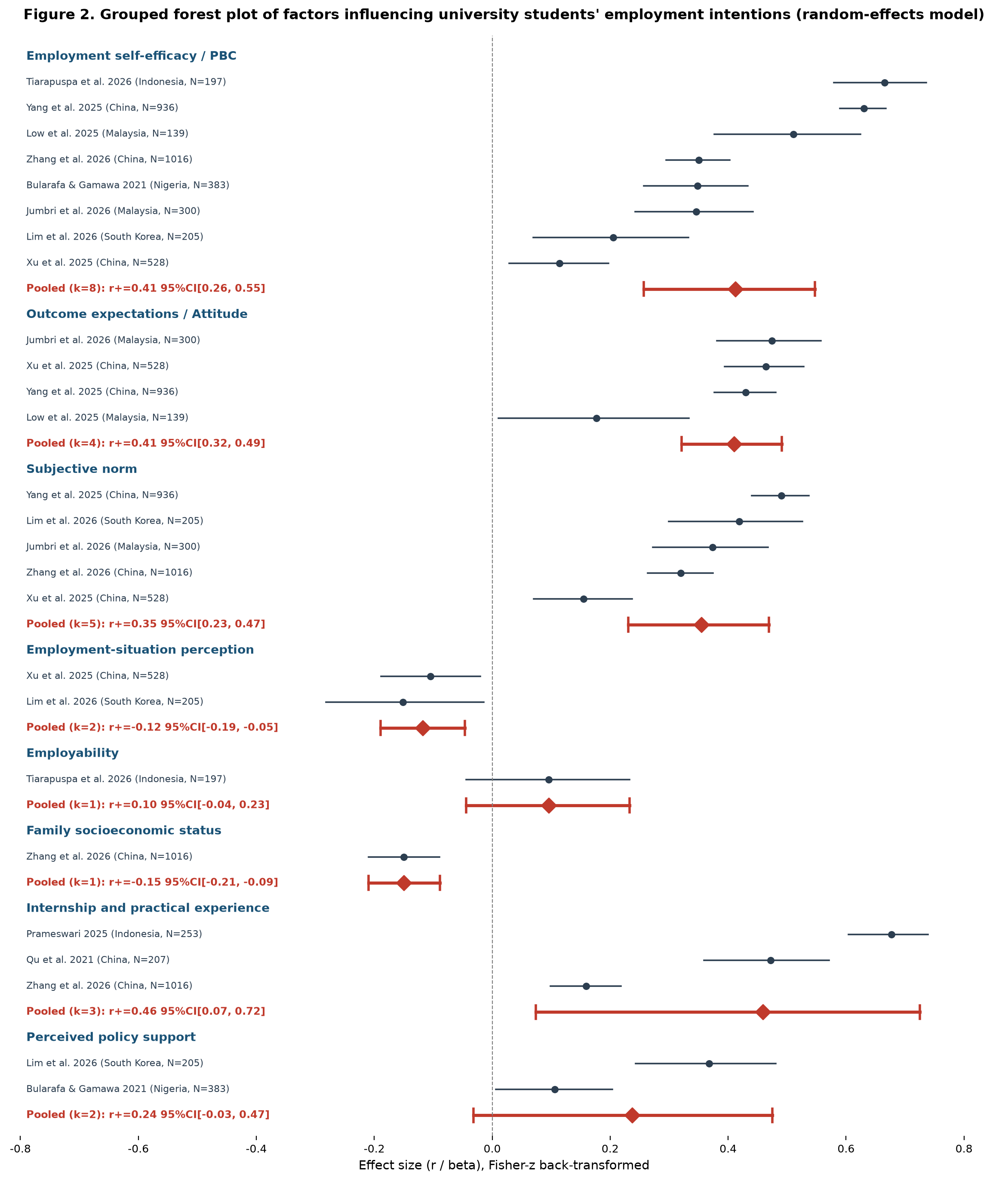
Figure 2. Grouped forest plot of factors influencing university students' employment intentions (random-effects model)
Regarding heterogeneity, four of the five pathways with \(k\geq 3\) exceed \(I^2=76\%\), with the internship and practical experience pathway reaching 97.9%, suggesting that the dispersion of effect sizes arises mainly from differences in measurement (internship satisfaction, internship achievement and rural experience correspond to three different "experience-intention" combinations). The employment-situation perception pathway has \(I^2=0\), with two highly consistent effects, but this homogeneity partly reflects the small sample sizes. Sources of heterogeneity are examined through subgroup and sensitivity analyses.
In terms of absolute magnitude, the proximal-variable effects obtained here are of the same order as general behavioural TPB meta-analyses (average correlations of attitude and perceived behavioural control with intention in the range 0.4-0.5 [9]), indicating that the strength of psychological antecedents of employment intention—a "high-commitment, low-frequency" major decision—does not systematically attenuate with the importance of the decision. The \(-0.118\) for employment-situation perception is a small effect, but the two effects come from Chinese medical students' return-home intention and Korean nursing students' entrepreneurial intention respectively, and their cross-context consistency strengthens the "risk-suppression" judgement. The confidence interval for perceived policy support crosses zero, which relates to the two effects coming from different scales (government entrepreneurship support and perceived government support) and very different samples (205 versus 383), and corroborates the qualitative literature on the "weak direct effect of policy". Although the single effects for employability and family socioeconomic status cannot be pooled, their point estimates fall in the "non-significant" and "significant small effect" ranges respectively, providing reference points for the mechanism discussion below.
4.2 Subgroup analysis
The three core pathways with sufficient effect sizes (employment self-efficacy, outcome expectations / attitude and subjective norm) were estimated by region (China/international), intention type (entrepreneurial/self-employment versus job-seeking and industry/regional employment) and effect-size reporting format (r/β), as shown in Table 5. By region, the Chinese (\(r^{+}=0.387\), \(k=3\)) and international (\(r^{+}=0.427\), \(k=5\)) samples have similar point estimates for employment self-efficacy with substantially overlapping confidence intervals; for outcome expectations the Chinese sample (0.442) exceeds the international sample (0.339); and for subjective norm the international sample (0.392) slightly exceeds the Chinese sample (0.330). By intention type, the effect of subjective norm on entrepreneurial / self-employment intention (0.438) is markedly higher than on job-seeking / industry-regional employment intention (0.242), consistent with the "endorsement" mechanism of subjective norm for high-risk choices (entrepreneurship) in collectivist cultures; employment self-efficacy and outcome expectations differ little between the two intention types. By reporting format, the pooled value for β-type effect sizes (0.455) is slightly higher than for r-type (0.390), but the confidence intervals overlap and do not signal systematic bias.
| Pathway | Subgroup dimension | Level | k | \(r^{+}\) | 95% CI |
|---|---|---|---|---|---|
| Employment self-efficacy | Region | Chinese sample | 3 | 0.387 | [0.066, 0.635] |
| International sample | 5 | 0.427 | [0.263, 0.567] | ||
| Intention type | Entrepreneurial / self-employment | 4 | 0.399 | [0.162, 0.592] | |
| Job-seeking / industry-regional employment | 4 | 0.426 | [0.199, 0.610] | ||
| Reporting format | Correlation r | 5 | 0.390 | [0.212, 0.542] | |
| Standardised coefficient β | 3 | 0.455 | [0.037, 0.737] | ||
| Outcome expectations / attitude | Region | Chinese sample | 2 | 0.442 | [0.400, 0.483] |
| International sample | 2 | 0.339 | [0.024, 0.593] | ||
| Intention type | Entrepreneurial / self-employment | 2 | 0.441 | [0.395, 0.485] | |
| Job-seeking / industry-regional employment | 2 | 0.336 | [0.032, 0.582] | ||
| Subjective norm | Region | Chinese sample | 3 | 0.330 | [0.139, 0.498] |
| International sample | 2 | 0.392 | [0.316, 0.464] | ||
| Intention type | Entrepreneurial / self-employment | 3 | 0.438 | [0.358, 0.511] | |
| Job-seeking / industry-regional employment | 2 | 0.242 | [0.075, 0.396] |
4.3 Sensitivity and publication-bias tests
The leave-one-out results are shown in Table 6. After removing each effect size in turn, the pooled value for employment self-efficacy fluctuates within \([0.370, 0.451]\), that for outcome expectations / attitude within \([0.381, 0.448]\), and that for subjective norm within \([0.314, 0.403]\); none shows a dramatic shift across the boundary between large and small effects, indicating that the main conclusions do not depend on any single study.
| Pathway | k | Full-sample \(r^{+}\) | Range of \(r^{+}\) after removal |
|---|---|---|---|
| Employment self-efficacy | 8 | 0.412 | [0.370, 0.451] |
| Outcome expectations / attitude | 4 | 0.410 | [0.381, 0.448] |
| Subjective norm | 5 | 0.355 | [0.314, 0.403] |
Regarding publication bias, given that none of the eight pathways reaches the \(k\geq 10\) prerequisite for funnel-plot testing, this study states honestly according to the pre-specified rule that the available evidence is insufficient to support a formal bias test. As a descriptive reference, Figure 3 presents the funnel plot and Egger regression result (\(t=1.844\), \(p=0.115\)) for the employment self-efficacy pathway, which has the most effect sizes (\(k=8\)); the scatter is broadly symmetric about the pooled value, with no significant asymmetry detected, though the power of the test with small samples is limited and the conclusion should be treated with caution [50,51].
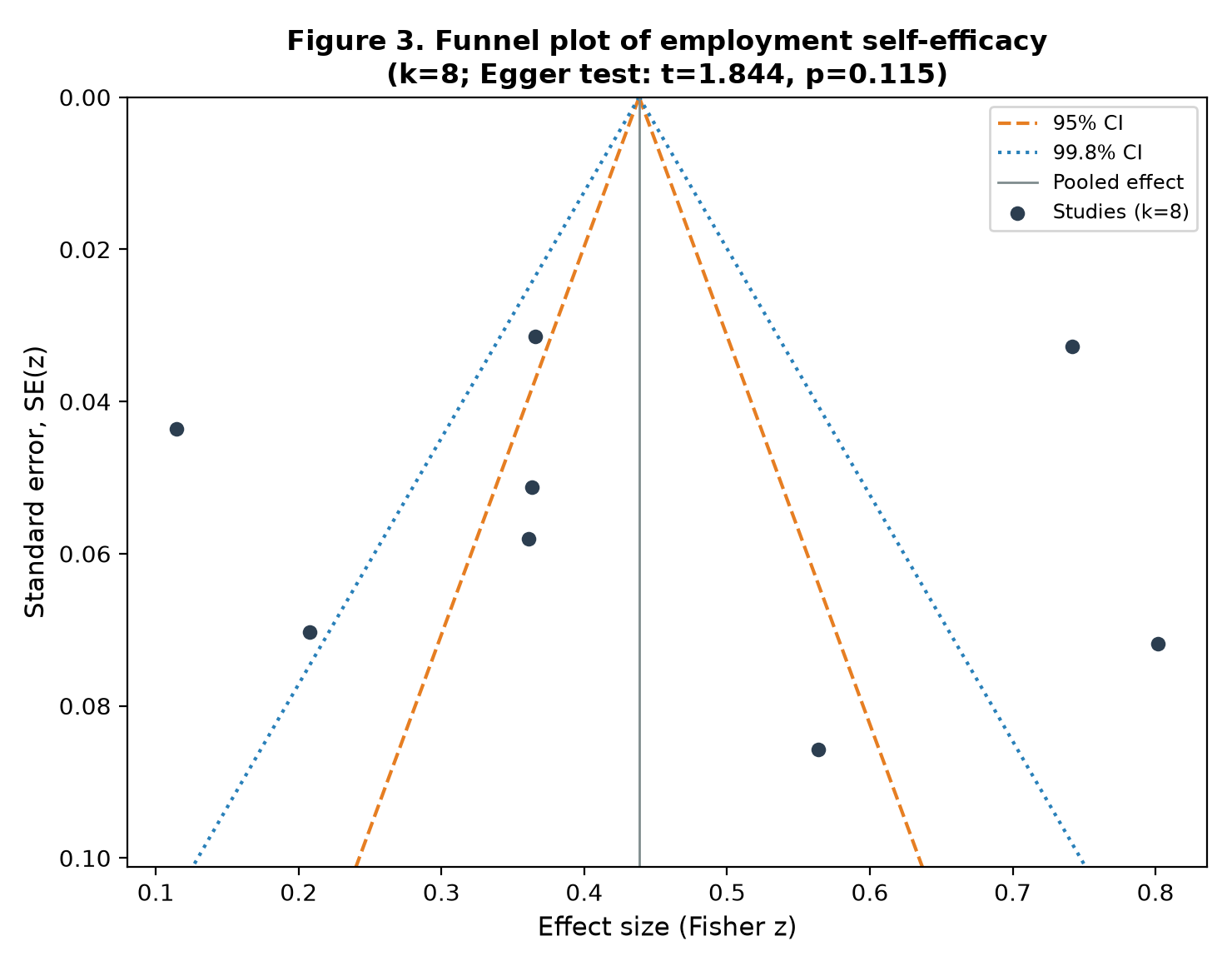
Figure 3. Funnel plot and Egger test for the employment self-efficacy pathway (\(k=8\); \(t=1.844\), \(p=0.115\); dashed lines mark the 95% and 99.8% pseudo-confidence boundaries)
4.4 Annual publication trend of the research topic
A search of the OpenAlex database shows that the annual number of publications on "employment intention / career intention" with students as the subject grew from 10 in 2000 to 618 in 2025, roughly a sixty-fold increase over 26 years (Figure 4). Growth accelerated markedly after 2019 (314 in 2019 → 440 in 2022 → 548 in 2023), coinciding with rising global youth employment uncertainty and the impact of the COVID-19 pandemic; this trend also implies rapid accumulation of empirical evidence and the need for meta-synthesis. It should be noted that the expansion of publication volume is not necessarily accompanied by a synchronous improvement in effect-size reporting quality: a substantial proportion of new literature remains at the level of significance testing, and the share of studies that can be quantitatively pooled is low; the gap between evidence supply and synthesis demand is itself a matter of scholarly concern.
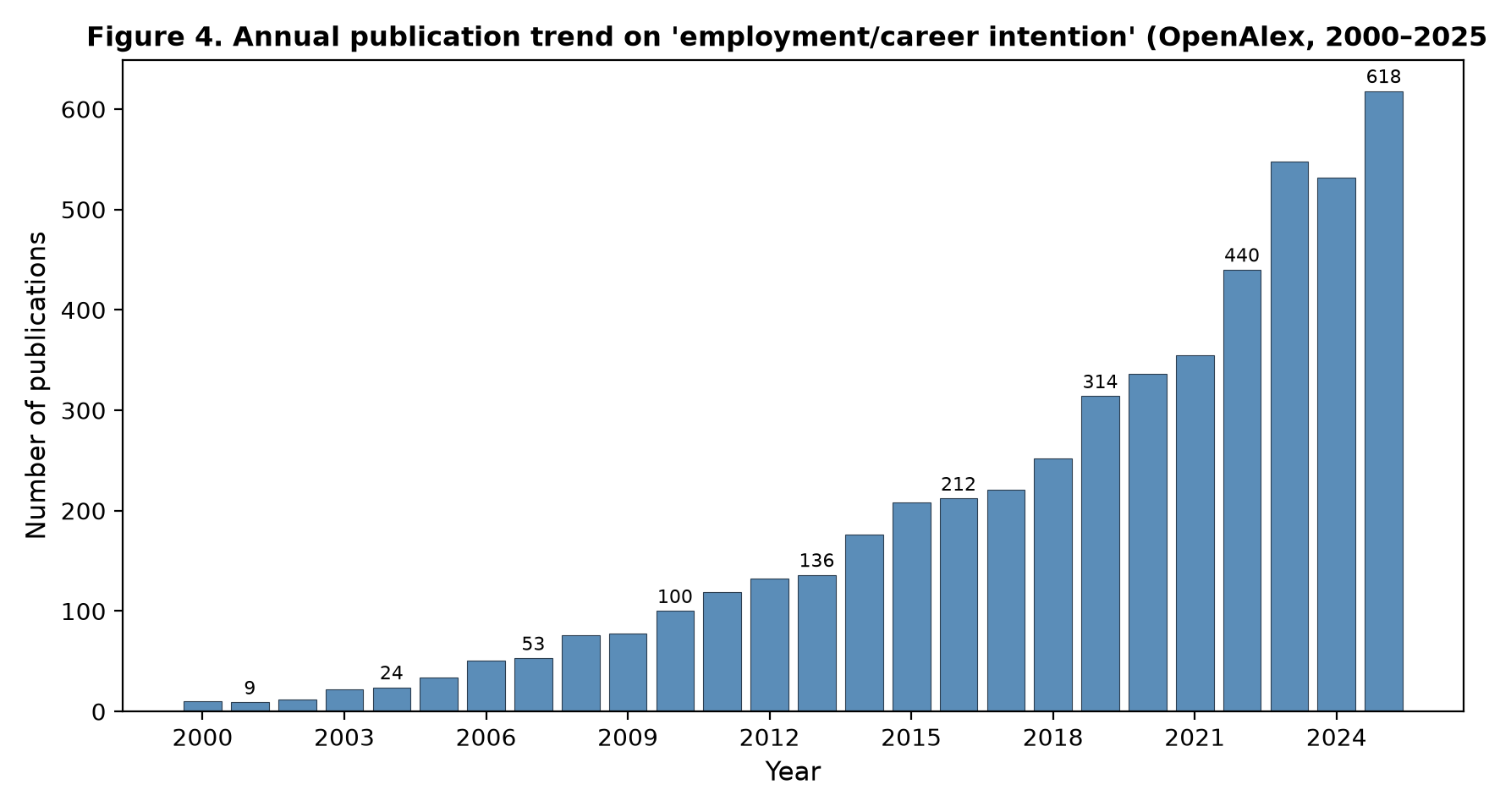
Figure 4. Annual publication trend on the theme of "employment / career intention" (OpenAlex, 2000-2025)
5. Discussion
5.1 Theoretical implications of the effect-strength ranking
The gradient structure of pooled effects broadly validates the core propositions of TPB and SCCT: as proximal "motivation-cognition" variables, employment self-efficacy (\(r^{+}=0.412\)) and outcome expectations / attitude (\(r^{+}=0.410\)) most strongly and cross-contextually stably explain employment intention, with effect magnitudes reaching a medium-to-strong level by Cohen's criteria [52]; this accords with the direction of Armitage and Conner's general-behaviour meta-analysis [9] and corroborates Sheu and colleagues' benchmark judgement that "self-efficacy and outcome expectations jointly contribute to choice goals" in the SCCT choice model [26]. The pooled effect for internship and practical experience (0.459) is numerically the highest, but its 97.9% heterogeneity indicates that the three effect sizes come from three different "experience-intention" combinations: internship satisfaction-industry career intention, internship achievement-industry career intention and rural experience-return-home intention. Their common meaning is that embodied practical experience (whether internship or rural life) converts into stronger intention commitment by providing competence credentials and career information that reduce choice uncertainty. This offers indirect support for the SCCT "experience-efficacy-choice" chain and illustrates the irreplaceable role of "learning by doing" in intention formation [40,41,45].
The pooled effect for subjective norm (0.355) is moderate, but its subgroup differences are informative: the effect on entrepreneurial / self-employment intention (0.438) is markedly higher than on job-seeking / industry-regional employment intention (0.242). A plausible explanation is that entrepreneurship, as a high-risk and unconventional path, more strongly requires "legitimacy endorsement" from significant others in collectivist cultures, so family and peer attitudes have greater leverage [20,36]; job-seeking and regional employment are more governed by objective labour-market signals, leaving less room for normative pressure. The weak negative effect of employment-situation perception (\(-0.118\)) is consistent with the "suppression" logic of risk perception—the more negative the evaluation of economic conditions and the employment environment, the lower the intention to, for example, start a business [19,20]; note, however, that the same perception may act in the opposite direction for "stability-seeking" intentions: Zheng and Yan, studying 542 Chinese students, found that the more negative the employment psychology (including a preference for stability), the stronger the direct employment intention, and that stability-seeking psychology was significantly positive for junior-college students [47]. This suggests that situation perception is a "double-edged sword" whose effect depends on the security-related attribute of the intention.
The relationship between subjective norm and peer effects also merits analysis. In the Korean sample the correlation between peer influence and entrepreneurial intention reached 0.569, the largest of all effect sizes [20]; a Chinese study based on nearly 100,000 randomly assigned class records estimated that a one-percentage-point increase in the proportion of classmates participating in internships raises the individual probability of participation by about 6.6%, and that university employment information services amplify while family background support weakens this peer effect [37]. Together these point to a "social information flow" mechanism: peer behaviour supplies the most accessible and vivid labour-market information and behavioural templates, and its effect can be seen as normative internalisation under an information cascade. Combined with the stable effect of family influence, this suggests that the social construction of employment intention runs simultaneously along two tracks—"vertical intergenerational expectations" and "horizontal peer modelling"—and that university careers guidance focusing only on the individual student while neglecting class and peer climate will miss an important intervention interface.
The contrast with the SCCT meta-analytic benchmark can be refined further. Sheu and colleagues' path synthesis shows that environmental support and barriers act on choice goals partly through the mediation of self-efficacy and outcome expectations, and that the contributions of these two variables to goals remain stable across the six Holland themes [26]. The corresponding structure in this study is highly consistent: the effects of environmental / experiential variables such as family influence, policy support and internship experience (0.355, 0.237 and 0.459) are overall lower than those of self-efficacy and outcome expectations (0.412 and 0.410), matching the mediational hierarchy in which "environmental variables are transmitted through cognitive variables". The difference is that in the SCCT interest model the contribution of outcome expectations to goals is usually slightly lower than that of self-efficacy, whereas in this study the two are almost equal, which may relate to the "cognitive-calculative" nature of employment intention—employment is an explicit cost-benefit trade-off, raising the weight of expected returns. This comparison suggests that TPB and SCCT are not competing frameworks in the employment domain but approach the same phenomenon from the sides of "motivational structure" and "competence-environment structure" respectively, and that the incremental value of integrated modelling merits testing in future primary studies.
5.2 Similarities and differences between the Chinese context and international samples
The point estimates for employment self-efficacy are close between Chinese (0.387) and international (0.427) samples, indicating that "efficacy-driven intention" is cross-culturally robust, echoing the stable conclusions of the SCCT meta-analysis across Holland themes [26]. Differences concentrate in two places. Outcome expectations / attitude is stronger in Chinese samples (0.442 vs. 0.339), which relates to Chinese studies predominantly using policy-sensitive intentions such as return-home, grassroots and self-employment intentions as dependent variables—the attitude evaluations of such intentions are embedded in policy narratives and local attachment and are thus more intense [19,45]; subjective norm is stronger in international samples (0.392 vs. 0.330), possibly because family influence is measured more purely in Korean and Malaysian samples (not mixed with social support), an explanation requiring testing in future research. The direct pooled effect of perceived policy support (0.237) is non-significant with very high between-study heterogeneity, consistent with the international finding that "policy mostly acts indirectly through attitude and efficacy": Xu et al. observed that perceived benefits influence return-home intention through attitude [19], Gong found that policy perception acts on grassroots employment intention through career decision-making efficacy and outcome expectations [17], Xiong et al. found that social support acts on job-search behaviour through career decision-making self-efficacy [53], the direct path of government support in the Nigerian sample is only 0.106 [36], and the moderating role of perceived government support is non-significant in a Jordanian sample [44]. By contrast, a report from an Indian sample found a correlation of 0.422 between perceived education policy and entrepreneurial intention [28], but that study reported no sample size and was of limited journal standing, so it was not included in the pooling. Overall, the direct pull of policy support on intention is limited, and its role operates more through the indirect channel of "altering expectations and efficacy", which poses a requirement for precise targeting in the policy design question of "how to translate policy publicity into policy perception and then into behavioural intention".
The two pathways with insufficient effect sizes require cautious discussion alongside qualitative evidence. For employability, only the Jakarta, Indonesia sample reported a direct effect (β=0.096), and the same study showed that its indirect effect through job-search self-efficacy (0.465) far exceeded the direct effect [33]; related Portuguese, Spanish and Chinese studies all report that self-perceived employability significantly predicts job-search intention or behaviour, but the accessible versions do not state specific coefficients [30,31,53]. It can thus be inferred that employability more likely acts as a "distal resource" that converts into intention through efficacy, rather than directly, consistent with Sheu and colleagues' meta-analytic conclusion that "competence experience acts on goals through self-efficacy" [26]. For family socioeconomic status, only the Hunan sample's family-income-return-home intention correlation (\(-0.150\)) is available [45], but Zhu et al.'s logit analysis of Hunan-origin students in Beijing shows that better family financial conditions and higher parental education predict lower interprovincial return employment intention [29]; Ling et al.'s survey finds that graduates with more highly educated parents are more inclined toward slow employment [39]; domestic research confirms that family socioeconomic status positively predicts career adaptability through psychological capital [38]; and a human-resources policy review notes that improved family financial conditions provide material support for slow employment [7]. Together these point to the judgement that socioeconomic status does not simply "increase or decrease" the total amount of employment intention but "regulates" its direction and tempo—resource-rich families support further study, slow employment and stays in first-tier cities, whereas resource-constrained families push their children toward early employment, return-home employment and stable public-sector posts. Modelling SES as a moderator rather than a linear predictor is a worthwhile direction for future research.
5.3 Corroboration with Chinese survey data
The meta-analytic conclusions and authoritative Chinese survey data can be mutually illuminating. First, the prevalence of "stability-seeking" intention can be explained by the combination of situation perception and subjective norm: in Zhaopin's 2024 survey 47.7% of graduates wished to enter state-owned enterprises and 51% considered "stability most important" [4], appearing alongside MyCOS's finding that the proportion preparing for civil service examinations doubled in five years [2,3], corresponding to weak negative situation perception (push) superimposed on the normative guidance of family networks; the Shanghai survey further shows that 91.0% of families of slow-employment graduates support their choice [6], highlighting the tacit function of subjective norm in "non-standard" path choices. Second, the persistently high intention to pursue further study (17.6% of the class of 2023 pursuing domestic postgraduate study [2], 18.4% of the class of 2024 [3]) can be seen as rational avoidance driven by "outcome expectations": when expected labour-market returns deteriorate, educational investment is assigned higher expected returns. Third, the rise in county and grassroots employment intention (the increasing share wishing to work in third- and fourth-tier cities and below in the Zhaopin surveys [4,5]) matches the predictions of the push-pull framework—high housing prices and competitive intensity in large cities create push factors, while lower living costs and emotional ties at home create pull factors; for grassroots policy to translate further into intention, the transmission from policy perception to attitude and efficacy must be addressed [17]. Table 7 summarises representative data from these surveys.
The gap between intention and actual behaviour should also be brought into the explanation. A survey of 482 medical graduates in ten western provinces found that 61.0% had a grassroots employment intention when they began job hunting and 68.9% ultimately chose grassroots posts, but only 64.6% of those who finally chose grassroots posts had held the corresponding intention initially, and after controlling for covariates the effect of initial intention on final choice was no longer significant [43]. This result cautions that the "intention formation" stage estimated by the meta-analysis is only the first link in the employment chain: between intention and signing a contract lie hard constraints such as job supply, information matching and bargaining power; employment policy cannot stop at "raising intentions" but must work continuously at the intention-behaviour interface (job creation, precise matching, signing support), otherwise mobilised intentions will turn into frustrating experiences in a mismatched market, eroding efficacy and expectations in reverse.
| Source | Survey year | Key indicators and values |
|---|---|---|
| MyCOS, China Undergraduate Employment Report 2024 [2] | Class of 2023 | Domestic postgraduate study 17.6%; awaiting employment 7.4%; preparing for postgraduate exams 6.2%; about 1/4 of the unemployed preparing full-time for civil service exams, with the share doubling in five years |
| MyCOS, China Undergraduate Employment Report 2025 [3] | Class of 2024 | Paid employment 60.6%; domestic postgraduate study 18.4%; 24% of those without a destination preparing full-time; entering government/public institutions 20%, state-owned enterprises 19% |
| Zhaopin, 2024 University Student Employment Competitiveness Survey [4] | Class of 2024 | Wishing to enter state-owned enterprises 47.7% (36% in 2020, rising for five consecutive years); government bodies 14.7%; private firms 12.5% (falling for five years); "stability most important" 51%; slow employment 19.1%; freelance 13.7% |
| Zhaopin, 2023 University Student Employment Competitiveness Report [5] | Class of 2023 | State-owned enterprise preference 46.7% (rising for three years); private firms 12.6% (falling for three years); government bodies 12.5% |
| Shanghai Survey Team, National Bureau of Statistics (cited via CCTV) [6] | 2023 | 38.0% of respondents in slow employment (32.0% further study, 6.0% delayed employment); family support rate for slow employment 91.0% |
| Economic Daily (class-of-2024 graduate scale) [1] | 2024 | 11.79 million university graduates projected nationwide, a historic high |
5.4 Limitations
This study has four limitations. First, the scale of included studies and effect sizes is limited (10 studies, 26 effect sizes), with insufficient effect sizes for perceived policy support, employment-situation perception, employability and family socioeconomic status (\(k\leq 2\)); the pooled values or single-case estimates for these pathways serve only as references, and formal conclusions await updates as evidence accumulates. Second, the effect-size metric mixes Pearson correlations with standardised regression / path coefficients; although subgroup analysis found no systematic bias, the shrinkage or inflation of β due to collinearity in multi-predictor models cannot be fully excluded, and the conversions from between-group t and R² introduce additional assumptions. Third, \(k<10\) for every pathway, so the funnel plot and Egger test have no formal inferential validity and publication-bias risk cannot be quantitatively ruled out; moreover some high-quality Chinese surveys (such as the nationwide logit studies [47,29]) were not pooled because their effect sizes could not be converted, potentially creating an evidence gap. Fourth, the included studies are predominantly cross-sectional, so causal directions (e.g. reciprocal causality between self-efficacy and intention) cannot be identified, and the coarse measurement of internship and rural experience also amplifies heterogeneity in the corresponding pathways.
6. Conclusions and Implications
6.1 Main conclusions
Within the integrated TPB × SCCT × push-pull framework, this study conducts a random-effects meta-analysis of 10 empirical studies and 26 effect sizes, yielding four conclusions. Employment self-efficacy and outcome expectations / attitude are the most robust proximal predictors of university students' employment intention, with pooled effects exceeding \(r=0.41\). Internship and practical experience has the numerically strongest effect on intention but the highest measurement heterogeneity, and its transmission to intention has a dual mechanism of "competence credentials" and "information acquisition". Subjective norm shows a type differentiation of "strong for entrepreneurship, weak for job seeking", with family and peer expectations playing a key role in non-standard path choices. Employment-situation perception has a weak inhibitory effect whose direction varies with the security attribute of the intention, perceived policy support has a weak and unstable direct effect and more likely acts indirectly through attitude and efficacy, and family socioeconomic status mainly regulates the direction rather than the total amount of intention. The leave-one-out tests and subgroup analyses support the robustness of these conclusions. Theoretically, these conclusions confirm the universality of the hierarchy in which "cognitive proximal variables precede environmental distal variables" across Chinese and international samples; methodologically, they demonstrate the usable boundary of small-sample evidence after pooling under a uniform metric; and they mark the specific locations where pathways with insufficient effect sizes await evidence.
6.2 Implications for university careers guidance and career education
The gradient of pooled effects provides a priority order for allocating university careers-guidance resources. First, place "efficacy cultivation" at the core of careers guidance: job-search skills training, mock interviews, career-person interviews and "small-success" task decomposition all target the four sources of self-efficacy (enactive mastery, vicarious experience, verbal persuasion and physiological/emotional states) [21]; the evaluation of careers-guidance courses should shift from "awareness rate" to changes in "sense of efficacy". Second, improve the quality density rather than merely the quantity of internships: the β of internship satisfaction for industry career intention reaches 0.472 [40], meaning that the quality of post matching, mentor guidance and achievement-feedback mechanisms determines whether an internship translates into industry commitment; for students oriented to grassroots and county employment, rural experience and grassroots secondments can supply equivalent "embodied experience" [45]. Third, implement differentiated guidance by intention type: for entrepreneurship-prone students, organise family-involved entrepreneurship mobilisation (exploiting the high leverage of subjective norm); for stability-prone students, provide a balanced presentation of information on public- and private-sector careers, avoiding excessive crowding onto a single path. Fourth, incorporate outcome-expectation interventions into career counselling: through transparent presentation of salary data and career-development paths, correct expected-return structures distorted by information asymmetry, alleviating the expectation mismatch in which "stability-seeking clustering" and "slow-employment waiting" coexist [2,4].
Differentiated guidance must also be moved earlier into the year groups. Lower-year students' intentions are often at a stage of "undifferentiated attitude", so career-exploration courses and diverse industry experiences should be used to broaden the choice set; final-year students' intentions are already strongly shaped by situation perception and peer comparison, so ability-profile-based job matching and psychological support in the job-search setting should be provided to prevent application setbacks from turning into efficacy losses; for the wait-and-see and avoidant group, "low-threshold actions" such as internship referrals and micro-credentials in skills should be used to rebuild the "action-feedback" cycle. Universities can establish a dynamic intention-monitoring mechanism to shift interventions from experience-driven to evidence-driven.
6.3 Policy implications
Policy design must confront the transmission reality of "weak direct effects and long indirect channels". Publicity for grassroots employment, talent-attraction and entrepreneurship-support policies should be upgraded from "policy-text push" to "case-based, concrete expectation restructuring", so that policy perception passes through attitude and efficacy rather than stopping at awareness [17,28]; building policy credibility (verifiable delivery of subsidies, establishment guarantees and career-development pathways) is key to raising the perception-to-intention conversion rate, and the direct path of only 0.106 for government support in the Nigerian sample together with the non-significant moderating effect in the Jordanian sample jointly suggest that policies "not perceived as delivered" cannot change intentions [36,44]. For the governance of slow employment, active and passive forms should be distinguished and addressed separately [7]: passive slow-employment graduates should be prioritised for internships, skills training and employment-information services, and graduates with family-resource constraints should receive job-search financial support, avoiding the individualised attribution of structural problems.
Viewing the full policy-transmission chain, shortcomings appear successively in three links. In the "policy-information" link, the project-based supply of grassroots and county policies (the Western Plan, the "Three Supports and One Assistance" programme, special-post teachers, etc.) relies on university employment offices for relay, so information transmission suffers delays and attenuation, and high-efficacy students paradoxically receive less, producing a mismatch of "able but kept at a distance". In the "information-cognition" link, policy incentives are mostly expressed in economic terms such as subsidy amounts and establishment types, lacking connection to individual career-development narratives and thus struggling to enter the calculation of attitude and expected returns. In the "cognition-intention" link, insufficientvisibility of policy implementation (long subsidy-reimbursement cycles, lack of feedback channels on the real conditions of posts) depresses perceived credibility, leaving policy support at the level of "known but not felt". Shifting the focus of policy communication from coverage to segment-by-segment repair of these three links—establishing targeted outreach mechanisms, adopting career-narrative expression and publishing implementation-feedback data—is the only way to translate policy resources effectively into changes in graduates' intentions. As regards the excessive concentration on the "civil service craze", the role of policy is to enlarge the visibility of quality private-sector posts and the level of employment protection, balancing the distribution of intentions by changing the comparison baseline rather than by administrative exhortation.
6.4 Research outlook
Future research can advance in four directions. Improve the standardisation of effect-size reporting, encouraging empirical studies to report complete correlation matrices or standardised path coefficients to provide comparable metrics for meta-synthesis; add longitudinal and experimental designs to identify the causal direction among efficacy, expectations and intention and the net effect of policy interventions; model family socioeconomic status as a moderator, examining its interactions with policy support and situation perception in shaping the direction of intention; and accumulate quantitative research on grassroots employment, civil-service and slow-employment intentions in the Chinese context, particularly filling the evidence gaps identified here (employability, policy support and SES pathways), and gradually reaching the scale of effect sizes needed to support funnel plots and bias tests.
The expansion of the digital economy and new forms of employment offers this field a new problem domain. Platform work, remote work and AI-assisted job hunting are changing the very boundaries of "employment", shifting the reference frame of intention formation from stable posts under the danwei system to composite careers built from skill portfolios and project opportunities; algorithmic recommendation of applications lowers search costs while potentially reinforcing the intention-behaviour mismatch of "applying equals acting". Quantitative investigation of these new mechanisms—such as the pathway by which digital literacy influences employment choice through career decision-making self-efficacy—has begun to appear in preliminary studies; extending the causal chain of intention research to the level of digital competence is a direction worth tracking. As evidence accumulates, meta-analyses of university students' employment intention should likewise evolve from the current exploratory synthesis toward systematic, pre-registered, pathway-by-pathway evidence updates, providing continuously updated quantitative grounds for higher-education and employment policy.
References
- [1] 经济日报. 大学生就业力报告发布:IT互联网仍是最向往行业[N/OL]. (2024)[2026-11-16]. https://www.jingjiribao.cn/static/detail.jsp?id=522420.
- [2] 麦可思研究院. 2024年中国本科生就业报告[M]. 北京: 社会科学文献出版社, 2024.
- [3] 麦可思研究院. 2025年中国本科生就业报告[M]. 北京: 社会科学文献出版社, 2025.
- [4] 智联招聘. 2024大学生就业力调研报告[R/OL]. (2024-05)[2026-11-16]. https://www.zhaopin.com.
- [5] 智联招聘. 2023大学生就业力报告[R/OL]. (2023)[2026-11-16]. https://www.zhaopin.com.
- [6] 央视网. 高校应届生为何选择"慢就业"? 这项专题调研给出分析[EB/OL]. (2023-09-14)[2026-11-16]. https://news.cctv.com/2023/09/14/ARTIRWmb6To16yz5X7hKrm97230914.shtml.
- [7] 中华人民共和国人力资源和社会保障部. 关注"慢就业"现象 助力青年顺利启航[EB/OL]. (2024-12-20)[2026-11-16]. https://www.mohrss.gov.cn/SYrlzyhshbzb/ztzl/dsschy/mtbd/202412/t20241220_532914.html.
- [8] AJZEN I. The theory of planned behavior[J]. Organizational Behavior and Human Decision Processes, 1991, 50(2): 179-211.
- [9] ARMITAGE C J, CONNER M. Efficacy of the theory of planned behaviour: a meta-analytic review[J]. British Journal of Social Psychology, 2001, 40(4): 471-499.
- [10] BLAU G. Testing a two-dimensional measure of job search behavior[J]. Organizational Behavior and Human Decision Processes, 1994, 59(2): 288-316.
- [11] KANFER R, WANBERG C R, KANTROWITZ T M. Job search and employment: a personality-integrative process model[J]. Journal of Applied Psychology, 2001, 86(4): 837-855.
- [12] ZAINAL N Z, HAIRUDDIN H, KASSIM E S. Psychological determinants of job search intention among fresh graduates for the supply of labour force in the digital era[J]. Asia Proceedings of Social Sciences, 2020, 6(3): 204-206.
- [13] LOW C W, MAH P Y, SHAARI N F, et al. Understanding job search intentions: a study on psychological drivers among Malaysian graduates[J]. Social and Management Research Journal, 2025, 22(1): 99-111.
- [14] TIEN D N. Investigating resilience, job search self-efficacy and intentions from integrating theory of planned behavior and social cognitive model of self-career management[J]. International Journal of Psychology and Behavioral Sciences, 2019, 9(2): 19-25.
- [15] DOANH D C, BERNAT T. Factors related to the intention of starting a business: a study among students in Vietnam[J]. Problemy Zarządzania, 2019, 17(6): 133-157.
- [16] ADAMS S P. Examining graduate applicant intentions to apply to an organisation: the theory of planned behaviour in the South African context[D]. Stellenbosch: Stellenbosch University, 2013.
- [17] 龚心玲. 政策感知对大学生基层就业意愿的影响: 职业决策效能感和职业结果预期的作用[D]. 石河子: 石河子大学, 2026.
- [18] YANG W, SONG F, JING H Y, et al. Psychometric testing of the theory of planned behavior-based self-employment intention scale and its application among Chinese undergraduate nursing students[J]. BMC Nursing, 2025, 24. DOI: 10.1186/s12912-025-04172-9.
- [19] XU W X, YANG J Y, ZHANG X R, et al. Building long-term mechanisms for medical students to find work in their hometowns within the framework of rural revitalization[J]. Scientific and Social Research, 2025, 7(3): 65-71.
- [20] LIM J Y, NOH W, VOHIDOVA M, et al. Factors associated with entrepreneurial intention among nursing students: a cross-sectional study using a socio-ecological model[J]. Nursing Open, 2026. DOI: 10.1002/nop2.70870.
- [21] BANDURA A. Self-efficacy: toward a unifying theory of behavioral change[J]. Psychological Review, 1977, 84(2): 191-215.
- [22] LENT R W, BROWN S D, HACKETT G. Toward a unifying social cognitive theory of career and academic interest, choice, and performance[J]. Journal of Vocational Behavior, 1994, 45(1): 79-122.
- [23] TAYLOR K M, BETZ N E. Applications of self-efficacy theory to the understanding and treatment of career indecision[J]. Journal of Vocational Behavior, 1983, 22(3): 356-369.
- [24] BETZ N E, KLEIN K L, TAYLOR K M. Evaluation of a short form of the career decision-making self-efficacy scale[J]. Journal of Career Assessment, 1996, 4(1): 47-57.
- [25] LENT R W, BROWN S D. Social cognitive model of career self-management: toward a unifying view of adaptive career behavior across the life span[J]. Journal of Counseling Psychology, 2013, 60(4): 557-568.
- [26] SHEU H B, LENT R W, BROWN S D, et al. Testing the choice model of social cognitive career theory across Holland themes: a meta-analytic path analysis[J]. Journal of Vocational Behavior, 2010, 76(2): 252-264.
- [27] LEE E S. A theory of migration[J]. Demography, 1966, 3(1): 47-57.
- [28] VIJAYALAKSHMI S, POORNA K, KANIMOZHI T. The role of education policy and institutional support in shaping entrepreneurial intention among university students in Coimbatore[J]. Minnesota Journal of Business Law and Entrepreneurship, 2026, 9(1).
- [29] 祝军, 李响, 柴方圆. 族望留原籍, 家贫走四方?——家庭背景对大学生省际回流就业意愿的影响作用研究[J]. 清华大学教育研究, 2024, 45(3): 139-149.
- [30] XIE Y Z, LIN Z, BARANCHENKO Y, et al. Employability and job search behavior: a six-wave longitudinal study of Chinese university graduates[J]. Employee Relations, 2017, 39(2): 223-239.
- [31] GOMES J, GAMBOA V, PAIXÃO O. Job search intentions in higher education: employability and self-efficacy[J]. Psicologia: Teoria e Prática, 2019, 21(2).
- [32] KIM K, CHAUDHARY A K, HAN A, et al. Factors associated with employment intentions of agriculture school students in South Korea[J]. The Journal of Agricultural Education and Extension, 2022, 28(4): 459-477.
- [33] TIARAPUSPA, RAHMADIANTI I S, WAHYUNINGSIH, et al. The effect of employability on Generation Z job search intention through self-efficacy with self-consciousness as moderating variable[J]. Jurnal Ilmiah Manajemen Kesatuan, 2026, 14(2): 2157-2168.
- [34] LI X L, PU R H, LIAO H L. The impacts of innovation capability and social adaptability on undergraduates' employability: the role of self-efficacy[J]. Frontiers in Psychology, 2022, 13: 954828.
- [35] WANG D, GUO D Y, SONG C, et al. General self-efficacy and employability among financially underprivileged Chinese college students: the mediating role of achievement motivation and career aspirations[J]. Frontiers in Psychology, 2022, 12: 719771.
- [36] BULARAFA B A, GAMAWA A I. Effect of personality traits and contextual factors on entrepreneurial intentions among undergraduate students of Nigerian universities[J]. Journal of International Business and Management, 2021, 4(1): 209.
- [37] WU W W, ZHONG Y Y, ZENG G H. Estimation of peer effect in university students' employment intentions: randomization evidence from China[J]. Frontiers in Psychology, 2023, 14: 1241424.
- [38] 徐程睿, 等. 大学生家庭社会经济地位、心理资本与生涯适应力的关系[J]. 心理学进展, 2023, 13(1). DOI: 10.12677/ap.2023.131019.
- [39] 凌香香, 谢颖珊, 陈姝帆, 等. 高校毕业生"慢就业"倾向调查研究[J]. 心理学进展, 2024, 14(6): 113-121.
- [40] QU H, LEUNG X Y, HUANG S S, et al. Factors affecting hotel interns' satisfaction with internship experience and career intention in China[J]. Journal of Hospitality, Leisure, Sport & Tourism Education, 2021, 28: 100311.
- [41] PRAMESWARI M B N. The impact of internship experience on students' career intentions in hospitality education[J]. Review of Management, Accounting, and Business Studies, 2025, 6(2): 155-162.
- [42] 刘慧瑜, 林淑涵, 郭昕怡. 高校大学生"慢就业"现象原因与对策探析[J]. 教育进展, 2023, 13(6): 3564-3568.
- [43] LIU J L, ZHU B, ZHANG N, et al. Are medical graduates' job choices for rural practice consistent with their initial intentions? A cross-sectional survey in western China[J]. International Journal of Environmental Research and Public Health, 2019, 16(18): 3381.
- [44] AL-OMAR S, ALALAWNEH A, HARB A. The impact of entrepreneurship education on entrepreneurial intention: the moderating role of perceived governmental support[J]. Education + Training, 2024, 66(7): 777-800.
- [45] 张婷, 张亚琦, 阳红. 乡村振兴背景下怀化高校大学生返乡就业创业的心理机制与支持体系研究[J]. 心理学进展, 2026, 16(10): 199-206.
- [46] JUMBRI I A, HERMAN E F N K, FAUZAN, et al. The role of entrepreneurship education in shaping self-employment intentions: a TPB-based study of Malaysian TVET students[J]. International Journal of Evaluation and Research in Education, 2026, 15(1). DOI: 10.11591/ijere.v15i1.35348.
- [47] ZHENG S N, YAN Y F. Changes in employment psychology of Chinese university students during the two stages of COVID-19 control and their impacts on their employment intentions[J]. Frontiers in Psychology, 2024, 15: 1447103.
- [48] DERSIMONIAN R, LAIRD N. Meta-analysis in clinical trials[J]. Controlled Clinical Trials, 1986, 7(3): 177-188.
- [49] HIGGINS J P T, THOMPSON S G. Quantifying heterogeneity in a meta-analysis[J]. Statistics in Medicine, 2002, 21(11): 1539-1558.
- [50] EGGER M, SMITH G D, SCHNEIDER M, et al. Bias in meta-analysis detected by a simple, graphical test[J]. BMJ, 1997, 315(7109): 629-634.
- [51] BORENSTEIN M, HEDGES L V, HIGGINS J P T, et al. Introduction to meta-analysis[M]. Chichester: John Wiley & Sons, 2009.
- [52] COHEN J. Statistical power analysis for the behavioral sciences[M]. 2nd ed. Hillsdale: Lawrence Erlbaum Associates, 1988.
- [53] XIONG Z B, ZENG M H, XU Y, et al. Linking career-related social support to job search behavior among college students: a moderated mediation model[J]. Behavioral Sciences, 2025, 15(3): 260.